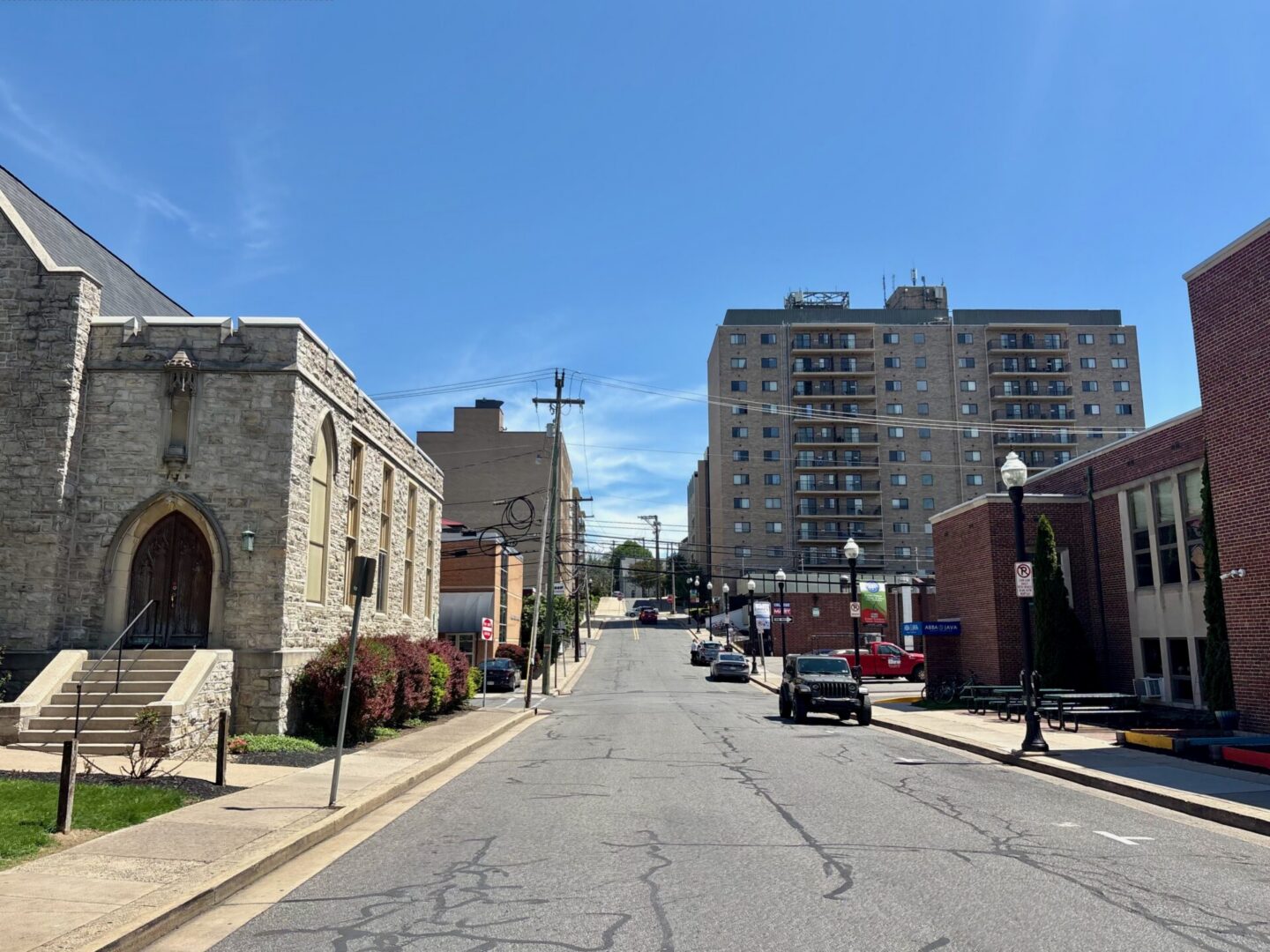
State College officials are considering a plan to convert segments of four streets to one-way traffic in an effort to address parking and loading zone shortages in the east end of downtown.
The borough Transportation Commission on Tuesday recommended approval of a one-year pilot program for the 100 blocks of Locust Lane, Hiester Street, Sowers Street and Hetzel
Street. The measure requires approval from the Borough Council, which is expected to review the proposal in June.
The plan would create one-way “couplets,” parallel streets with traffic permitted in opposite directions. Locust Lane would be one-way southbound (toward East Beaver Avenue) and nearby Hiester Street one-way northbound (toward East College Avenue). For the other couplet, Sowers Street would be one-way southbound and Hetzel Street one-way northbound.
“When you are talking about one-way streets, you generally want to have them mirrored,” borough transportation engineer Ron Seybert said during an April 14 discussion of the proposal. “So if someone’s going in one direction and wants to come back the other way, there is another street nearby where they can make that trip in the opposite direction.”
Eliminating one travel lane on each of the four street segments would allow for the addition of a total of about 30 metered parking spaces and six loading zones, Parking Department supervisor of operations Matthew Pieper said.
It would also address what Pieper called “extremely dangerous and unsafe parking actions” that have been observed in the area.
“In this area of town, what we often see is people waiting on the wrong side of the road for pick-ups and drop-offs,” he said. “We have a lot of semis and folks like that sitting on Beaver and Garner, creating a lot of unsafe situations. This is just an idea to help clear out all of that while giving more legal space for people to do their operations.”
Each of the streets has “relatively low traffic volumes that are well under the street classification threshold,” Seybert wrote in a memo included in the April 14 and May 12 Transportation Commission agendas. Intersections at both ends of each street are stop-controlled, so there would be no impact on traffic signals.
An initial concept had the one-way directions of Locust and Hiester reversed. However, Seybert noted that the Dumpsters at The Maxxen can only be accessed and loaded by garbage trucks traveling northbound, and that “the intersection corner sight distance at Locust and College is not desirable for pedestrians and vehicles.”
Locust Lane south of Beaver Avenue currently runs one-way northbound, meaning through-traffic for the length of Locust would not be possible in either direction. Transportation Commission members asked staff to consider reversing Locust south of Beaver to be one-way southbound, so that bicycles and vehicles have another south-direction through-street between Pugh and High streets.
Seybert said staff can evaluate, though not implement, the possibility during the pilot, and noted it would also require discussions with residents and business owners.
“The residents in there, but there are businesses also in that section of Locust Lane, south of Beaver Avenue,” he said. “It is important to consider what that might mean to their operations and the people that live there.”
Commission members also asked if the entire length of Locust could be made a north and south bicycle corridor. Seybert, however, said residential and commuter zone parking on Locust between Beaver and Hamilton would need to be removed entirely to accommodate the bike lanes, and noted that Locust is not included in the borough’s Next
Generation Safety and Mobility Plan as a multi-modal corridor.
Bike lanes on the proposed one-way blocks — another ask from commission members — are also unlikely.
“Based upon the width of the streets that we have out there, we don’t have enough room to create that dedicated bicycle lane while maintaining the parking or loading lane on the other side of the street,” Seybert said, adding that, like Locust, none of the other segments are in the Next Gen plan as proposed multi-modal corridors.
Bicycle lanes also cannot be installed between parking rows and the curb under Pennsylvania law, Seybert said.
The streets, though, do provide opportunities for expanded pedestrian infrastructure, with pedestrian nodes for better sight lines and possible future widening of sidewalks, as well as street furniture and bike racks.
“Under a pilot program, we’re probably not going to do anything permanent,” Seybert said. “But if the pilot program seems good and viable, then as those streets come up for reconstruction, we can look at changing curb lines and putting expanded sidewalk zones where these things can be more permanent. There is the possibility to do temporary with pavement markings and tubular markers to delineate that space.”
Testing the one-way conversions through a pilot program would allow an opportunity to conduct the traffic analysis required for a permanent change. The drawback is that if the patterns are found to not be suitable, “we may have to undo everything that we did with respect to signings and markings,” Seybert said.
Other drawbacks include adding distance to vehicle and bicycle trips, potential for wrong-way movements and traffic confusion, according to a list of pros and cons provided to the commission. The document noted that a publicity campaign would be needed before implementation.
In addition to increasing metered spaces and eliminating some unsafe illegal parking, advantages of the conversion include more loading zones for businesses and ride shares, improved pedestrian safety and better set-ups for student move-in and move-out.
The Downtown State College Improvement District and Retail Advisory Committee both expressed support for the one-way conversions, Parking Department director Tom Brown said.
If the pilot is approved, borough staff want it to be implement over the summer so that it will be in place when Penn State students return in late August.
“If possible, we would like to implement this before the student return in the fall so that when they come back, this is already in place,” Brown said. “It will also help tremendously with student move-in. If anybody was down in that area of town last week, it was an absolute zoo. That’s one of the worst areas of town that we have as far as illegal parking, especially around the Hiester/Locust areas. If we do not implement this before students return, we’re going to have to put in some type of temporary measures on these streets with the amount of construction that’s going on down there to provide parking and loading and unloading zones for these families.”